In the Lambda cold dark matter paradigm, giant galaxies grow by repeated mergers of smaller systems. Dwarf galaxies, the most common type of galaxies in the universe, are probably the closest approximation to the building blocks of larger galaxies. In particular, dwarf spheroidal galaxies (dSph) around the Milky Way provide important clues to understand formation and evolution of galaxies, because their proximity enables us to spatially resolve the galaxies into individual stars.
Spectroscopic observations of dSphs revealed sizable metallicity spreads among their constituent stars. The observed internal abundance inhomogeneity in dSphs can be produced by the following two mechanisms: (a) If the dSphs were able to keep their gas against their earliest supernova explosions, the gas could turn into stars with higher metallicity than the first generations. In this case, the newer stars are expected to be centrally concentrated within galaxies, leading to a rather strong radial gradient in metallicity; (b) If dSphs were made by the agglomeration of even smaller progenitors (i.e., proto-dwarfs), the merger-induced star formation and accompanying chemical enrichment can cause abundance inhomogeneity. In this case, the radial gradient in metallicity is expected to be weak.
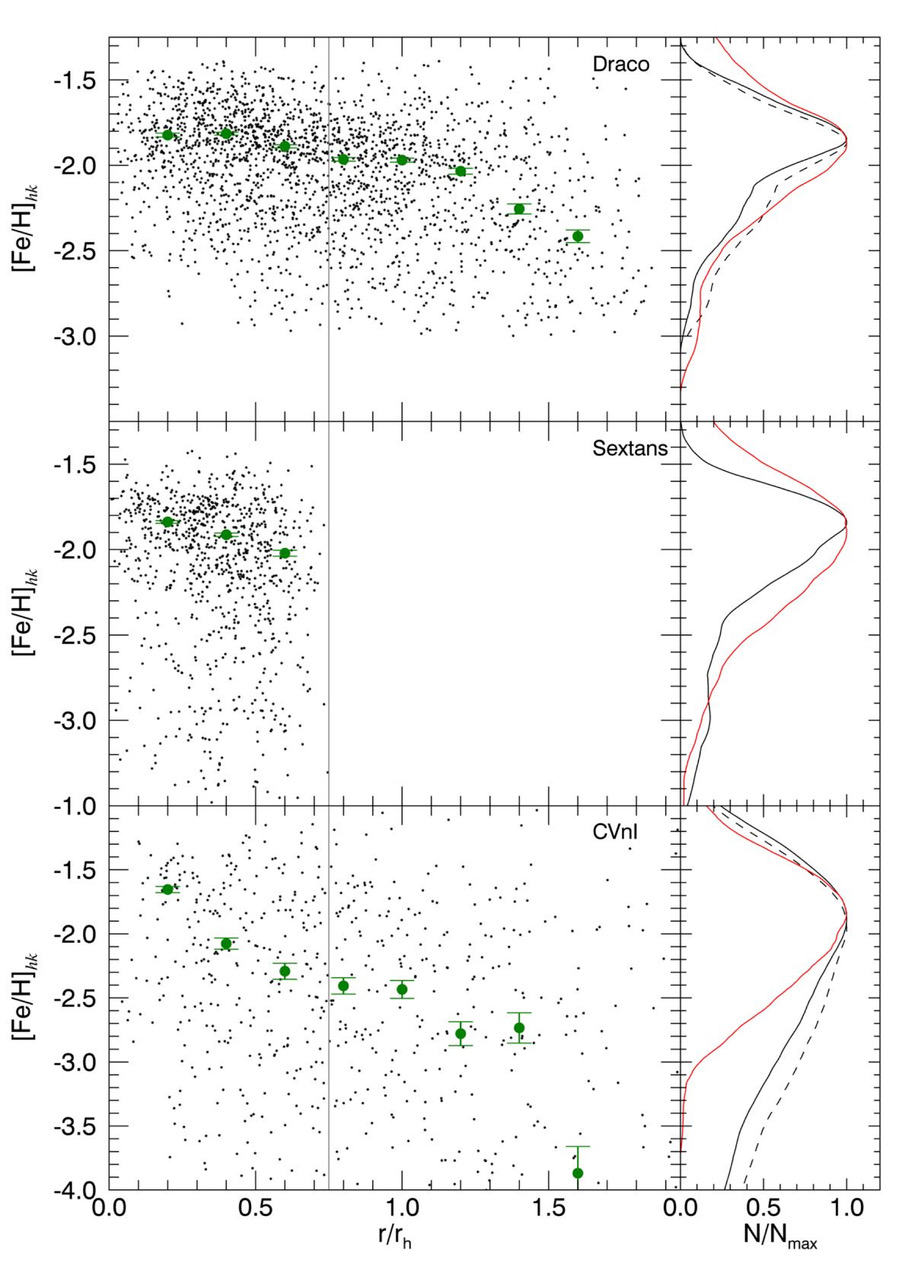
For a better understanding of the chemical enrichment history in dSphs, examining the structural feature of stellar populations as a function of metallicity is needed. However, such chemical plus structural examination, to which we refer "chemo-structural study" is hindered by the lack of stars with spectroscopic metallicity. Here we propose the Ca-by photometry as an alternative way to secure metallicities for 2-3 orders of magnitude larger stellar sample than spectroscopic sample and thus enable to perform a chemo-structural study on dwarf galaxies. In particular, we use the hk index [=(Ca-b)-(b-y)], whose validity as a photometric metallicity indicator (and crass insensitivity to age) for red-giant-branch stars was upheld via Galactic globular clusters, and observe three dwarf spheroidal galaxies (Draco, Sextans, and Canes Venatici I) with Subaru/Suprime-Cam.
We find that in all the galaxies the metal-rich stellar populations are more centrally concentrated than the metal-poor counterparts, suggesting that the central regions of the galaxies underwent extended star formation. Such negative radial metallicity gradient for Sextans and Canes Venatici I opposes to the traditional spectroscopic results. We also find that their metallicity distribution functions (MDFs) can be characterized by a unimodal, skewed Gaussian shape with a metal-rich peak and a metal-poor tail. The unimodal, skewed MDFs arise naturally in an aggregate of a large number of protogalactic gas clouds from its virtually continuous chemical evolution through many successive rounds of star formation.
In the Data page, we provides the Ca-by photometric measurements of point sources in the three dSphs with CHI and SHARP parameters.
|
|
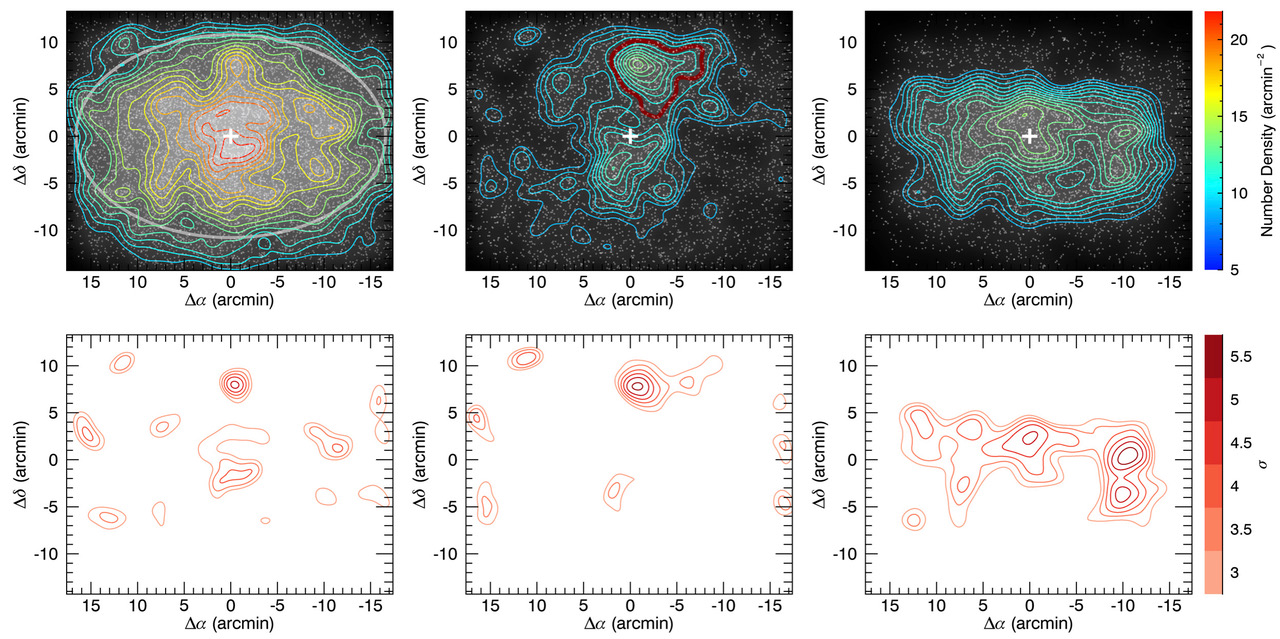
Figure2. Upper row: spatial distributions of all member stars (left), metal-poor stars (center), and metal-rich stars (right) brighter than V=24.0 along with the surface number density contours from the two-dimensional Kernel density estimation using the Sheather & Jones (1991) bandwidth. The images are rotated so that the major axis of Sextans is along the x-axis. North is to the top left, and east is to the bottom left. The white cross represents the center of the galaxy (Irwin et al. 1990), and the gray ellipse denotes the core radius and ellipticity. In the central panel, an unexpected number excess of metal-poor stars is visible at about 7.7 arcmin northwest from the galaxy center. The thick red locus is the isodensity contour of 7.5 arcmin^-2 and the selection area for stars associated with a possible relic star cluster (see the text). Lower row: statistical significance contours from 3 sigma in steps of 0.5 sigma. The significance is estimated from bootstrap tests with 1000 replicate resamplings for each group. The off-centered peak of the metal-poor stars visible in the upper central panel is statistically significant (~5.5 sigma).
|
The Sextans dSph at a distance of ~86 kpc is one of the recently discovered satellite galaxies of the Milky Way with a very low surface brightness (μV = 28.17 ma/arcsec^2) and unusually large extent on the sky (r_h=16'.9). Previous studies have suggested that it possesses kinematic substructure in the central region. Kleyna et al. (2004) suggested the presence of a kinematically cold core in the inner five arcmin of the galaxy. Walker et al. (2006), however, did not confirm the presence of such a core but instead detected another kinematically cold substructure north of the center at the core radius. Battaglia et al. (2011) detected similar cold kinematic substructure composed of metal-poor stars presumably belonging to a star cluster. Karlsson et al. (2012) argued that the chemical properties of the six most metal-poor stars observed by Aoki et al. (2009) indicate the presence of a dissolved star cluster within this galaxy. Roderick et al. (2016) found an overdense region near the galaxy center as well as an extended halolike stellar substructure in the outskirts of Sextans. Cicuendez & Battaglia (2018) detected shell-like stellar overdensity in the spatial distribution of red stars in g-r. They also found a ringlike kinematic substructure suggesting a past accretion event.
In this study, we investigate the chemo-structural properties of stellar populations in Sextans and report a possible discovery of a relic star cluster in the galaxy. Using the hk index as a photometric metallicity indicator, we discriminate the metal-poor and metal-rich stars in the galaxy. From the spatial distribution of metal-poor stars, we found an unexpected number density peak at about 7.7 arcmin (~190 pc in projected distance) northwest from the center of the galaxy. The V-I color-magnitude diagram (CMD) for stars around the density excess reveals that both the main sequence and the giant branch are considerably narrower and redder than the bulk of field stars in Sextans. Our stellar population models show (a) that the narrow CMD is best reproduced by a simple stellar population with an age of ~13 Gyr and [Fe/H] of -2.3 dex, and (b) that the redder V-I color of the hk-weak population is explained only if it is ~2 Gyr older than the field stars. The results lead us to conclude that the off-centered density peak is likely associated with an old, metal-poor globular cluster. The larger spatial extent (>80 pc in radius) and the smaller number of stars (~1000) than typical globular clusters point to a star cluster that is in the process of dissolution.
The finding serves as the first detection of a surviving star cluster in Sextans, supporting previous suggestions of the presence of star cluster remnants in the galaxy.
The survival of a star cluster within Sextans provides an important clue for the core-cusp problem. Several numerical simulations (e.g., Kleyna et al. 2003; Lora et al. 2013) suggest that star clusters can persist for a Hubble time preferentially in the cored dark matter (DM) halo than in the cuspy DM halo. Assmann et al. (2013a, 2013b) predicted, in their dwarf galaxy formation model, that, in a cored DM halo, some of star clusters can survive through the Hubble time if their apocentric distance is close enough (<300 pc; see also Alarcon Jara et al. 2018) to reside in the core region where little potential gradient is present. The star cluster we identified has a projected distance of ~190 pc from the galaxy center, and this could explain the reason why the old cluster was not completely dissolved yet. Our results thus provide a piece of evidence in favor of the cored DM halo profile of this dwarf galaxy.